Category: South — Action

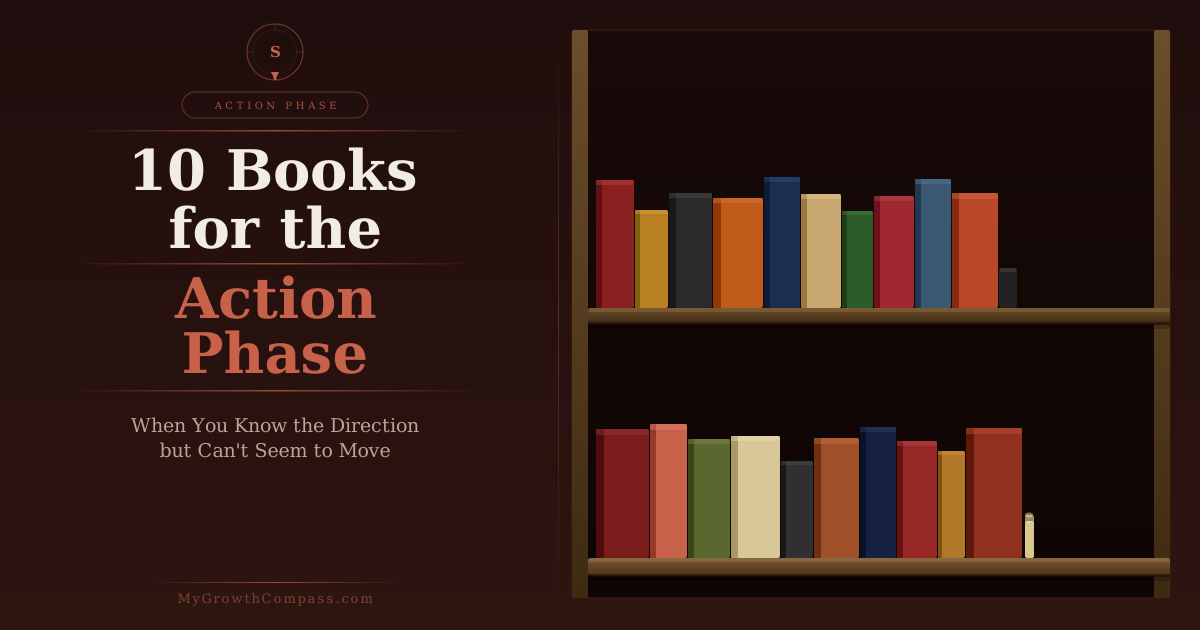
  • 10 Books for the Action Phase (When You Know the Direction but Can’t Seem to Move)

    10 Books for the Action Phase (When You Know the Direction but Can’t Seem to Move)

    There is a specific kind of stuck that does not get talked about enough.

    It is not the lost kind. You are past that. You have done the reading, the journaling, the late-night conversations about what you really want. You have a direction — maybe not a perfect one, but something. And yet you are still here. Still preparing. Still waiting for the right moment, the right conditions, the right version of yourself to show up before you start.

    That is the Action phase. And the problem is not that you do not know what to do. The problem is that you are not doing it.

    In the Growth Compass framework, Action sits at the West point of the DARP cycle — the stage where knowing has to become moving. It is where most people stall out longest, because the gap between intention and execution is wider than anyone tells you. The self-help world is full of books about finding your purpose and reflecting on your journey. There are far fewer books about the unglamorous, uncomfortable work of actually showing up and doing the thing.

    These 10 books are for that gap. They are not about discovering yourself. They are about getting out of your own way.

    (Want to understand where Action fits in the full framework? Start here: The Growth Compass Method: A Navigation System for Growth.)

    1. Atomic Habits — James Clear

    The foundational Action phase book. Clear’s argument is simple and useful: stop focusing on goals and start focusing on systems. The person who wants to run a marathon and the person who runs three times a week are not the same person yet — and the gap between them is not motivation, it is habit design. This book gives you the mechanics to close that gap one small rep at a time. If you only read one book on this list, make it this one.

    2. The War of Art — Steven Pressfield

    Pressfield names the thing that keeps Action phase people stuck: Resistance. Not laziness, not lack of talent, not the wrong circumstances — Resistance. That internal force that shows up every time you sit down to do the work that matters. This book does not hand you a productivity system. It tells you that the work is a war, Resistance is the enemy, and your only job is to show up anyway. Short, brutal, and exactly what the Action phase requires.

    3. Shoe Dog — Phil Knight

    The only memoir on this list, and one of the best books ever written about what Action actually looks like in practice. Knight built Nike without a clear plan, without adequate funding, and without any guarantee it would work. He just kept moving — through failure, near-bankruptcy, and constant uncertainty. This book is not motivational. It is honest. And that honesty is what makes it so useful for someone standing at the edge of their own leap.

    4. Eat That Frog — Brian Tracy

    The title is ugly. The advice is not. Tracy’s core idea is straightforward: identify the most important task in front of you and do it first, before anything else, every single day. No warm-up, no inbox, no easing in. The frog is the thing you are avoiding. Eating it first means your day cannot be a failure no matter what happens after. Simple to understand, hard to do consistently, and exactly the kind of direct intervention the Action phase requires.

    5. Deep Work — Cal Newport

    This is not about doing more. It is about doing what matters with your full attention. Newport makes the case that the ability to focus without distraction is becoming rare and increasingly valuable — and that most people in the Action phase are busy but not productive. There is a difference between filling your day with activity and doing the work that actually moves things forward. This book draws that line clearly and shows you how to get to the other side of it.

    6. The One Thing — Gary Keller

    One of the most useful questions in the Action phase is also the one most people avoid: what is the single thing that, if you did it, would make everything else easier or unnecessary? Keller builds an entire framework around that question. For someone stalled by too many options or too many competing priorities, this book cuts through the noise and gives you a way to identify the one lever worth pulling right now.

    7. Finish — Jon Acuff

    Most productivity books are about starting. This one is about finishing — which is a completely different problem. Acuff’s research found that perfectionism is the number one reason people abandon things they care about. The fix is not trying harder. It is cutting your goal in half, giving yourself permission to do it imperfectly, and removing the conditions that make quitting feel logical. Underrated book that directly addresses the most common Action phase failure pattern.

    8. Can’t Hurt Me — David Goggins

    Not for everyone. If you are looking for gentle encouragement, this is the wrong book. Goggins grew up in poverty, was abused, struggled with obesity, and became one of the most decorated endurance athletes alive — not through talent but through a relentless refusal to accept his own excuses. His core argument is that most people are operating at roughly 40 percent of their actual capacity. Read it if you need a hard reset on what you are genuinely capable of.

    9. Discipline Is Destiny — Ryan Holiday

    Holiday reframes discipline not as punishment but as freedom. The argument is that self-control — over your time, your attention, your impulses — is what makes sustained action possible. Without it, you are at the mercy of whatever feels urgent or comfortable in the moment. With it, you can build almost anything. This book is part philosophy, part biography, and entirely relevant for anyone in the Action phase who keeps getting pulled away from what matters.

    10. Indistractable — Nir Eyal

    Distraction is the modern Action phase killer. Eyal’s book goes deeper than most on why we get pulled away from the things we say matter — and his answer is uncomfortable: most distraction is not external, it is internal. We reach for our phones not because the phone is compelling but because the work is hard. Indistractable is the most practical book on this list for anyone who knows exactly what they should be doing and keeps finding reasons not to do it.

    Which stage are you actually in?

    Action is the phase where things either start to compound or start to unravel. The books above are built for people who are ready to move but need the right tools, the right mindset, or just a hard push in the right direction.

    If you are not sure whether you are in Action or still in Discovery, The Growth Compass Method: A Navigation System for Growth walks through all four stages and what each one actually feels like from the inside.

    The next stage after Action is Reflection — where you slow down, process what happened, and extract what it meant. That post is coming. But first, you have to do something worth reflecting on.
  • Growth Compass Challenge Week 2: Action

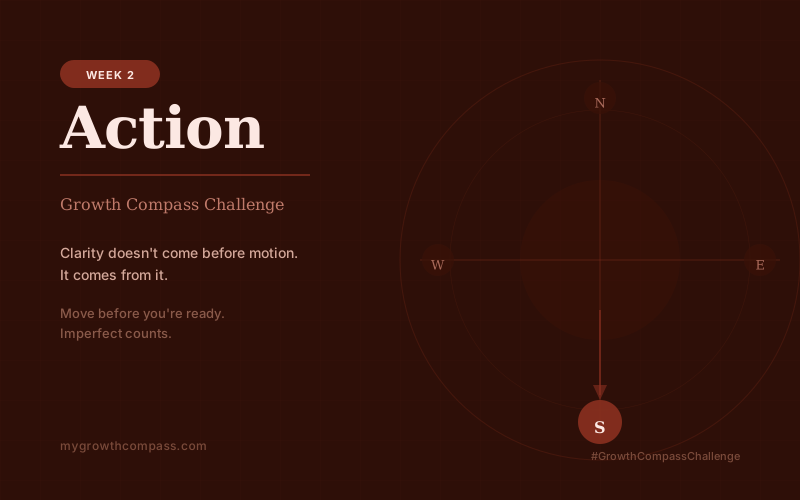
    Growth Compass Challenge Week 2: Action

    Clarity doesn’t come before motion. It comes from it.

    That’s the premise of Action Week — the second direction on the Growth Compass. Last week was about getting honest about where you are. This week is about moving from that place, before you feel ready, before you have it figured out.

    Most people wait for certainty before they act. But certainty is a result of action, not a requirement for it. The compass doesn’t point you somewhere and then tell you to move. It reveals direction through the act of moving.

    This is Week 2 of the Growth Compass Challenge. If you missed Week 1, start there — the Discovery prompts are still live and worth doing first.


    HOW THIS WORKS

    Each day this week has three parts:

    A compass prompt — a short provocation or insight to sit with.

    A micro-exercise — one concrete action, under 15 minutes.

    A reflection question — something to journal, think through, or share in the comments.


    DAY 8 — The Smallest Possible Step

    The block isn’t that you don’t know what to do. The block is that what you know you should do feels too big to start. Cut it smaller.

    Exercise: Take one thing from last week — a curiosity, an avoidance, a pull — and define the smallest possible action toward it. Not the right action. The smallest one. Do it today.

    Reflection: What would happen if you treated this small step as enough for today?


    DAY 9 — Change One Thing in Your Environment

    Your environment is either working for your direction or against it. Most people try to outperform their surroundings through willpower. That’s the harder path.

    Exercise: Identify one thing in your physical or digital environment that consistently pulls you away from where you want to go. Change, remove, or relocate it today. One thing only.

    Reflection: What would your space look like if it was deliberately designed around your current direction?


    DAY 10 — Do the Thing You’ve Been Overthinking

    There’s probably one specific thing you’ve been circling for days — researching, planning, reconsidering. At some point the thinking is no longer preparation. It’s a substitute for moving.

    Exercise: Identify the thing you’ve thought about most this week without doing. Do a version of it today. An imperfect version counts.

    Reflection: What were you actually waiting for?


    DAY 11 — Borrow Someone Else’s Momentum

    You don’t always have to generate your own energy to move. Sometimes the fastest way to get into motion is to get near someone who already is.

    Exercise: Find a podcast episode, book chapter, interview, or conversation with someone operating in a direction that interests you. Spend 20 minutes with it today. Notice what it stirs up.

    Reflection: Who in your life or in your feed makes you feel like your direction is possible? How much time are you spending near them?


    DAY 12 — Track What You Actually Do, Not What You Planned

    Plans are hypotheses. What you actually do is data. Most people review the plan. Few people review the execution.

    Exercise: At the end of today, write down what you actually did — not what you intended. No judgment. Just an accurate record. Compare it to what you planned this morning.

    Reflection: What does the gap between plan and action tell you about where your real resistance lives?


    DAY 13 — Ship Something Imperfect

    Perfection is a form of inaction dressed up as a standard. Finishing something imperfect teaches you more than polishing something forever.

    Exercise: Complete something today and call it done. A draft, a message, a decision, a small creative thing. Done means sent, posted, submitted, or committed to — not just finished in your head.

    Reflection: What is one thing you’ve been “almost done” with for more than a week?


    DAY 14 — Action Integration: What Did Moving Teach You?

    Seven days of motion generates more useful information than seven weeks of thinking about motion. That information is now available to you. Use it.

    Exercise: Write down three things you learned about yourself this week — not things you did, but things you learned from doing them.

    Reflection: What did action reveal that planning could not have?


    WHAT’S NEXT

    Week 3 drops next Monday: Reflection.

    Motion without reflection is just busy. Reflection turns experience into direction.

    Drop your Week 2 integration answer in the comments — what did moving teach you that thinking couldn’t?

  • Why Confidence Comes From Action (Not the Other Way Around)

    Why Confidence Comes From Action (Not the Other Way Around)

    Once people begin recognizing opportunities around them, a new obstacle usually appears.

    Fear.

    Not dramatic fear, but a quieter hesitation. Doubt about whether they are ready, capable, or qualified to move forward.

    At this point many people assume they need confidence before they take action.

    In reality, the process works the other way around.

    Confidence is usually the result of action, not the prerequisite for it.


    The Confidence Myth

    Confidence is often treated like a personality trait.

    Some people appear naturally confident, while others believe they simply are not.

    This belief creates a frustrating cycle. People wait to feel ready before they begin, but readiness rarely arrives without experience.

    Those who seem confident are rarely born that way.

    More often, they have simply accumulated more attempts.

    Each attempt builds familiarity with uncertainty, and familiarity reduces fear.

    What looks like confidence from the outside is often just experience over time.


    Why Action Changes Everything

    When someone tries something new, the first attempt is usually uncomfortable.

    There are unknowns. Mistakes feel more visible. Progress is uncertain.

    But something important happens after the first step.

    The situation becomes familiar.

    The second attempt feels slightly easier. The third attempt feels more manageable. Over time the fear that once felt overwhelming becomes ordinary.

    Action transforms uncertainty into experience.

    Experience gradually becomes confidence.


    Small Actions Matter More Than Big Ones

    Many people delay action because they believe the first step must be significant.

    They imagine launching a major project, making a dramatic career change, or committing to something that feels permanent.

    Most real progress begins much smaller.

    A conversation with someone experienced in the field.
    Learning the basics of a new skill.
    Testing an idea on a small scale.
    Exploring a possibility without pressure to succeed.

    Small actions reduce the cost of failure while still creating experience.

    And experience is the raw material confidence is built from.


    Confidence Is Built Through Repetition

    The pattern is surprisingly consistent.

    The first attempt creates awareness.

    The second attempt builds familiarity.

    Repeated attempts build competence.

    Competence eventually produces confidence.

    At no point does confidence appear first.

    It emerges gradually as the result of movement.

    This is why people who take action consistently often appear more confident than those who wait for certainty.

    They have simply spent more time building experience.


    Action in the Growth Compass

    Within the Growth Compass framework, confidence marks the beginning of Action — the southern direction where ideas start interacting with the real world. Within the Growth Compass framework, confidence marks the beginning of Action.

    Discovery helps people understand themselves, interpret their emotions, and recognize opportunity.

    Action is where those insights start interacting with the real world.

    Confidence grows when ideas stop living only in thought and begin turning into attempts.

    Not every attempt will succeed.

    That is part of the process.

    Each attempt still produces information.

    That information becomes the raw material for the next stage of growth.


    Confidence does not arrive before action.

    It grows because of it.

    When you start moving, uncertainty begins to shrink.

    Experience begins to accumulate.

    And what once felt intimidating slowly becomes familiar.

    Not sure where you are in the cycle?

    The Growth Compass Quiz takes 5 minutes and shows you which direction your energy is pointing right now.

    Take the Quiz →

    The next obstacle most people encounter is not fear.

    It is overthinking.

    Next: Stop Overcomplicating Everything

Train Your Compass