Category: East — Discovery

  • 10 Books for the Discovery Phase (When You Don’t Know What You Want Yet)

    10 Books for the Discovery Phase (When You Don’t Know What You Want Yet)

    There is a specific kind of restlessness that does not have a clean name.

    You are not in crisis. Nothing is technically wrong. But something has shifted — quietly, without warning — and now you are reading articles at midnight, listening to podcasts on your commute, and comparing your path to people you barely know. You are consuming information at a pace that would suggest you are searching for something. You are just not sure what.

    That is the Discovery phase. And it is more common than most people admit.

    In the Growth Compass framework, Discovery is the first stage of the DARP cycle — the phase where you are questioning, exploring, and gathering signal before you have any clarity about direction. It sits at the East point of the compass. Not because it is where the journey ends, but because it is where most people actually begin: eyes open, orientation unclear, curiosity active.

    The tricky part about Discovery is that most self-help content is not built for it. Most books assume you already know what you want and just need a system to get there. They hand you a 90-day plan before you have figured out what you are planning for. That mismatch is why so many people in this stage read the books, take the notes, and still feel stuck.

    These 10 books are different. They are for the questioning stage, not the doing stage. They open possibilities instead of prescribing action. They are comfortable sitting with uncertainty — which is exactly what this phase requires.

    (Not sure which stage you are in? Start here: The Growth Compass Method: A Framework for Anyone Who Feels Lost.)

    1. Designing Your Life — Bill Burnett and Dave Evans

    This one was written specifically for people who do not have a clear direction yet. The premise is simple: you cannot think your way into a new life — you have to prototype it. Burnett and Evans, both Stanford design professors, walk you through low-stakes experiments that help you gather real information about what fits and what does not, without requiring a dramatic commitment first. It is the most practical book on this list for someone who is stuck in their head.

    2. Ikigai — Hector Garcia and Francesc Miralles

    The concept of ikigai — the Japanese idea of a reason for being — maps almost perfectly onto the Discovery phase. The book explores the intersection of what you love, what you are good at, what the world needs, and what you can be paid for. It does not give you the answer. It gives you a better set of questions, which is what Discovery actually requires.

    3. Big Magic — Elizabeth Gilbert

    This is the book to read if you are waiting for passion to arrive before you move. Gilbert argues that curiosity is a more reliable guide than passion, and that following curiosity — even when it seems small or impractical — is how most meaningful work actually starts. It reframes the entire search in a way that feels less desperate and more honest. Recommended especially if the restlessness feels creative in nature.

    4. The Alchemist — Paulo Coelho

    Yes, it is fiction. Yes, it belongs here. The Alchemist is about following a signal without knowing where it leads — which is the emotional experience of Discovery compressed into a story. It gives permission to not have the full picture yet. If you have already read it, read it again with the framework in mind. It lands differently.

    5. Man’s Search for Meaning — Viktor Frankl

    Frankl wrote this after surviving the Nazi concentration camps. It is not a light read, but it is a foundational one. His core argument is that meaning is not found — it is made, out of whatever circumstances you are in. For someone in Discovery who is waiting for life to feel meaningful before they commit to anything, this book is a quiet corrective. It is also short. You can read it in an afternoon.

    6. What Color Is Your Parachute? — Richard N. Bolles

    This book has been revised almost every year since 1970 because the core process still works. It is usually filed under career books, but it belongs in the Discovery phase for anyone — not just people changing jobs. The exercises are designed to help you understand what you are actually wired for before you decide where to point that energy. If you are blank-page stuck, this gives you something concrete to work with.

    7. StrengthsFinder 2.0 — Tom Rath

    The book comes with an access code for the CliftonStrengths assessment, which is the real value here. The assessment gives you language for things you are already doing naturally — talents you may have dismissed as unremarkable because they come easily to you. In Discovery, one of the most useful things you can do is get clearer on your own wiring. This makes that process faster.

    8. Maybe You Should Talk to Someone — Lori Gottlieb

    Gottlieb is a therapist who ends up in therapy herself. The book moves between her sessions with her own therapist and her sessions with four very different patients. It normalizes the exploration process — the confusion, the resistance, the slow emergence of clarity — in a way that is harder to get from a framework or a list. It also quietly argues that most people are asking the wrong questions about their own lives. Worth reading if the Discovery phase feels emotionally charged, not just logistically uncertain.

    9. The Artist’s Way — Julia Cameron

    This is a 12-week program built around two practices: morning pages (three pages of longhand, stream-of-consciousness writing every morning) and artist dates (solo weekly outings designed to feed your curiosity). It was written for creative blocks but works just as well for any kind of directional fog. Morning pages alone function as a Discovery tool — you write until you stop performing and start actually saying something. Something usually surfaces within a few weeks.

    10. Essentialism — Greg McKeown

    This might look like an Action book — and in some ways it is. But McKeown starts with something Discovery requires: a serious interrogation of what actually matters to you, stripped of what you think should matter. The first third of the book is about stepping back, observing, and questioning assumptions before making any moves. Read it as a thinking tool, not a productivity system.

    Which stage are you actually in?

    Discovery is just one point on the compass. Some people reading this are further along than they think — already in Action but stalling out. Others might be in Reflection without realizing it, processing something that happened rather than searching for something new.

    If you are not sure where you are in the cycle, The Growth Compass Method is a good place to start. It walks through all four stages and what each one actually feels like from the inside.

    And if you are deep in Discovery right now — restless, questioning, not quite sure what comes next — that is not a problem to fix. It is the beginning of a process. You are in the right place.

  • Growth Compass Challenge Week 1: Discovery

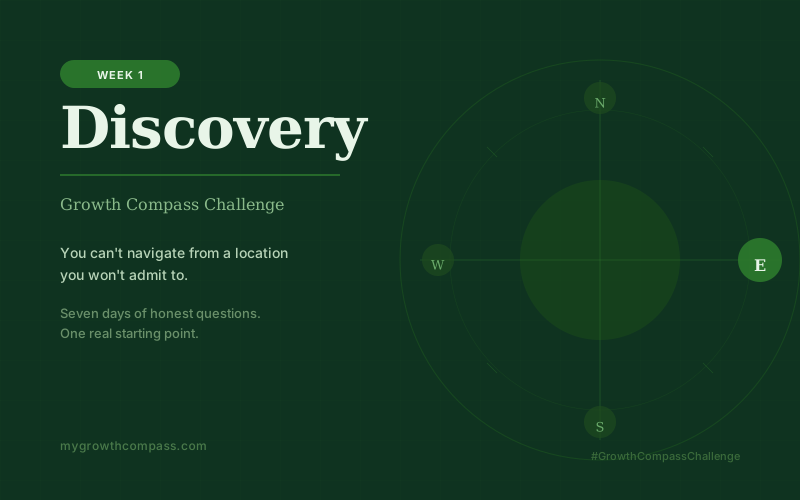
    Growth Compass Challenge Week 1: Discovery

    You can’t navigate from a location you won’t admit to.

    That’s the premise of Discovery Week — the first direction on the Growth Compass. Before you can figure out where you’re going, you have to be honest about where you actually are. Not where you wish you were. Not where you used to be. Where you are today.

    This is Week 1 of the Growth Compass Challenge: a free four-week cycle moving through Discovery, Action, Reflection, and Purpose. One direction per week. Seven prompts and exercises per week. No pressure to have it figured out before you start.

    That’s the whole point.


    HOW THIS WORKS

    Each day this week has three parts:

    A compass prompt — a short provocation or insight to sit with.

    A micro-exercise — one concrete action, under 15 minutes.

    A reflection question — something to journal, think through, or share in the comments.

    You don’t have to do every single one. Start with Day 1. See what happens.


    DAY 1 — Where Are You Actually Starting From?

    Most people begin a new challenge from where they wish they were. This one starts from where you are. The compass only works if you’re honest about your current position.

    Exercise: Write three sentences — no more — that describe where you genuinely are right now. Not goals. Not history. Today. Keep them.

    Reflection: What did you leave out of those three sentences because it felt uncomfortable to write?


    DAY 2 — What Are You Actually Curious About?

    Curiosity doesn’t show up as a grand calling. It shows up as a small, persistent pull toward something you keep thinking about, reading about, or mentioning in conversation.

    Exercise: Look at your browser tabs, your podcast queue, and the last five things you searched. Write down the theme you see. What subject keeps reappearing?

    Reflection: When did you last follow a thread of curiosity just to see where it went, with no goal attached?


    DAY 3 — What Are You Avoiding?

    Avoidance is directional. What you consistently sidestep tells you as much about your compass as what you move toward.

    Exercise: Write down one thing you’ve been putting off for more than two weeks. Underneath it, write the real reason — not the logistical excuse. The actual reason.

    Reflection: Is this avoidance protecting you from something, or just postponing it?


    DAY 4 — What Would You Try If Wasting Time Wasn’t a Risk?

    A lot of people aren’t afraid of failure. They’re afraid of finding out they spent months on something that didn’t lead anywhere. But discovery doesn’t work on a guarantee.

    Exercise: Name one thing you’ve wanted to explore but haven’t started because you couldn’t see the payoff in advance. Write it down. You don’t have to act on it yet — just name it clearly.

    Reflection: Where did the belief that exploration needs a justified outcome come from?


    DAY 5 — What Pulls You Without Prompting?

    You don’t have to manufacture passion. You already have pulls. Most people just override them before they can be useful.

    Exercise: Think about the last time you lost track of time doing something — not relaxing, actually doing something. What were you doing? Write it down and note how long it’s been since you did it.

    Reflection: If that pull isn’t part of your current direction, why not?


    DAY 6 — Who Are You When Nobody’s Watching?

    Your real priorities are the ones you keep when there’s no audience. Strip the performance and what’s left is closer to your true compass setting.

    Exercise: Look at your unscheduled hours this past week — the time you didn’t plan. Write down what you actually did with them, not what you intended to do. What does that reveal?

    Reflection: Is the person you are when no one is watching someone you would choose to be?


    DAY 7 — Discovery Integration: What Did This Week Reveal?

    Discovery isn’t about finding answers. It’s about asking better questions. One week in, the questions are already sharper than they were seven days ago.

    Exercise: Go back to your Day 1 sentences. Write three new ones about where you are today. Notice what shifted, even slightly.

    Reflection: What is one thing you now know about your current direction that you were not willing to see a week ago?


    WHAT’S NEXT

    Week 2 drops next Monday: Action.

    Clarity doesn’t come before motion. It comes from it.

    Drop your Week 1 reflection in the comments — what did Discovery reveal that you weren’t expecting?

  • Awareness of Opportunity: Learning to See What Others Miss

    Awareness of Opportunity: Learning to See What Others Miss

    Once people begin understanding themselves and their emotional patterns, something subtle begins to change.

    They begin noticing opportunities they previously ignored.

    This does not happen because the world suddenly becomes more generous. It happens because perception changes.

    Most opportunities are already available.

    They simply go unnoticed until awareness is elevated.


    Why Opportunity Is Often Invisible

    Opportunity is rarely obvious.

    When people imagine opportunity, they tend to picture dramatic moments — a life-changing idea, a perfect job offer, or a sudden breakthrough.

    Real opportunities are usually quieter than that.

    They appear as small openings, interesting problems, or situations that spark curiosity. They might look like a skill worth learning, a conversation worth having, or a problem that no one else seems eager to solve.

    The difficulty is not the absence of opportunity.

    The difficulty is seeing it.


    Why Some People Notice Opportunities Earlier

    When you think about people who seem successful, it is easy to assume they simply found better opportunities.

    In many cases, they did not.

    They simply learned to recognize opportunities earlier than others.

    Awareness plays a major role.

    People who understand their own interests and emotional signals develop a kind of internal filter. When something aligns with their curiosity or abilities, it stands out.

    The same situation might appear ordinary to someone else.

    This is why two people can encounter the exact same environment and walk away with completely different paths.

    One person saw an opening.

    The other did not.


    Opportunity Often Hides Inside Problems

    Another reason opportunity goes unnoticed is that it rarely looks comfortable.

    Many of the most meaningful opportunities are disguised as problems.

    A confusing process at work.
    A frustrating gap in a system.
    A skill that few people seem willing to learn.

    Where some people see inconvenience, others see possibility.

    That shift in perspective is powerful.

    Instead of avoiding problems, you begin asking a different question:

    Is there something here worth exploring?

    Sometimes the answer is no.

    But sometimes that curiosity leads to something important.


    Curiosity Is the Key to Seeing Opportunity

    The easiest way to develop opportunity awareness is not through complicated strategy or planning.

    It is through curiosity.

    Curiosity encourages exploration without immediate pressure to succeed. It allows people to investigate ideas, environments, and challenges without needing a perfect plan.

    When curiosity is active, opportunities become easier to recognize.

    You start noticing patterns.

    You start seeing gaps where something could be improved.

    You begin asking questions that others overlook.

    Those questions often lead to movement.


    The Final Step of Discovery

    Within the Growth Compass framework, awareness of opportunity represents the final stage of Discovery — the eastern direction where new signals and possibilities first come into view.

    At this point, three things have started to develop:

    Self-awareness reveals who you are.

    Emotions highlight what matters to you.

    Opportunity awareness shows where those interests might connect to the real world.

    This combination creates a powerful starting point.

    Once you begin recognizing opportunities that align with your curiosity and strengths, the next step becomes unavoidable.

    Action.

    Because eventually, curiosity wants to be tested in the real world.

    Not sure where you are in the cycle?

    The Growth Compass Quiz takes 5 minutes and shows you which direction your energy is pointing right now.

    Take the Quiz →

    Next: Confidence

  • Emotions: What They’re Actually Trying to Tell You

    Emotions: What They’re Actually Trying to Tell You

    Once people begin to understand themselves more clearly, something interesting happens.

    Emotions become harder to ignore.

    Self-awareness tends to bring feelings to the surface. Frustration about work. Excitement about certain ideas. A quiet sense that something in life is slightly off.

    Many people interpret these emotions as problems that need to be controlled or suppressed.

    But emotions are rarely the enemy.

    More often, they are signals.


    Why Emotions Feel So Complicated

    Most people were never taught how to interpret emotions. Instead, they were taught how to manage them.

    Stay calm.
    Don’t overreact.
    Keep your feelings under control.

    Those lessons are useful in certain situations, but they leave out something important.

    Emotions are information.

    They tell us when something matters, when something feels wrong, when something aligns with who we are, and when something does not.

    Ignoring that information makes direction harder to find.


    Emotions Are Signals, Not Instructions

    One reason emotions create confusion is that people treat them as commands.

    If something feels uncomfortable, the instinct may be to avoid it. If something feels exciting, the instinct may be to chase it immediately.

    But emotions are not instructions.

    They are signals.

    Frustration might be pointing toward a problem worth solving. Anxiety might reveal uncertainty that needs attention. Excitement often highlights areas where curiosity and interest are already present.

    The goal is not to obey every emotion.

    The goal is to understand what it might be trying to reveal.


    What Emotions Often Reveal

    When people begin paying attention, patterns start to appear.

    Certain situations create energy. Others drain it.

    Some problems feel engaging even when they are difficult. Others feel exhausting even when they are simple.

    Emotions help reveal these patterns.

    For example:

    • Frustration can highlight areas where you care more deeply than you realized
    • Curiosity often appears where learning feels natural
    • Boredom sometimes signals that something no longer fits who you are becoming
    • Satisfaction tends to follow work that aligns with your interests or values

    These emotional responses are not random.

    They are clues about direction.


    Learning to Listen Without Overreacting

    Understanding emotions does not mean letting them control every decision.

    Instead, it means observing them with curiosity.

    Curiosity allows you to notice emotional signals without immediately reacting to them.

    Ask questions such as:

    • Why did that situation affect me so strongly?
    • What exactly created that excitement or frustration?
    • Is this feeling pointing toward something I care about?

    Over time, this habit becomes incredibly useful.

    Emotions stop feeling like unpredictable obstacles and start functioning as feedback.

    They help reveal what matters.


    The Role of Emotions in Discovery

    Within the Growth Compass framework, this stage belongs to Discovery — the eastern direction where new signals and possibilities first appear.

    Discovery is not just about exploring ideas in the outside world. It also includes learning how your internal signals respond to those experiences.

    Self-awareness reveals who you are.

    Emotions help you understand how different parts of life interact with that identity.

    Together, they create a clearer picture of where energy naturally flows.

    Once emotional signals become easier to recognize, another kind of awareness begins to develop — the ability to notice opportunities that others miss.

    Not sure where you are in the cycle?

    The Growth Compass Quiz takes 5 minutes and shows you which direction your energy is pointing right now.

    Take the Quiz →

    Next: Awareness of Opportunity

Train Your Compass