Blog

  • Growth Compass Challenge Week 4: Purpose

    Growth Compass Challenge Week 4: Purpose

    Purpose isn’t where you start. It’s where you end up.

    That’s the premise of Purpose Week — the fourth and final direction on the Growth Compass. Three weeks of Discovery, Action, and Reflection are behind you. This week we look at what all of it has been pointing toward.

    Purpose doesn’t arrive as a vision or a calling. It arrives as an accumulation of honest moments — curiosity you followed, actions you took, patterns you noticed, things you were willing to sit with. After three weeks of paying attention, there is more material here than you might think.

    This is Week 4 of the Growth Compass Challenge. The previous three weeks are still live if you want to go back. But if you’ve been running the cycle, this is where things start to clarify.


    HOW THIS WORKS

    Each day this week has three parts:

    A compass prompt — a short provocation or insight to sit with.

    A micro-exercise — one concrete action, under 15 minutes.

    A reflection question — something to journal, think through, or share in the comments.


    DAY 22 — What Has This Month Revealed?

    Purpose doesn’t arrive as a vision. It arrives as an accumulation of honest moments. Three weeks of honest moments is a lot of material to work with.

    Exercise: Write down three things you know about yourself now that you didn’t know — or wouldn’t admit — 22 days ago. They don’t have to be big. Accurate matters more than significant.

    Reflection: If these three things are true about you, what do they suggest about what direction you should be moving?


    DAY 23 — What Matters More Than You Thought?

    The things that consistently show up in your curiosity, your avoidance, your energy, and your reflection are not random. They’re telling you what matters to you under all the noise.

    Exercise: Look back across the last three weeks. Write down three themes that came up again and again — in your prompts, your exercises, your reflections. These are your recurring signals.

    Reflection: What would change if you treated those signals as real information instead of coincidence?


    DAY 24 — What Would You Pursue Even If It Was Hard?

    Passion fades. Difficulty stays. What you’re willing to work through reveals more about your real direction than what excites you on a good day.

    Exercise: Name one thing — a direction, a project, a way of living — that you would pursue even knowing it would be frustrating, slow, or uncertain. Write down why you’d still do it.

    Reflection: Is that thing anywhere in your current life right now? If not, why not?


    DAY 25 — What Are You Becoming?

    You’re not trying to find a fixed destination. You’re tracking the direction of who you’re turning into. That’s different — and more useful.

    Exercise: Write three to five sentences describing the person you are becoming based on the evidence of the last 25 days. Not who you want to be. Who you’re actively turning into.

    Reflection: Is that the person you want to be? If yes, what accelerates it? If no, what would redirect it?


    DAY 26 — What Feels True Now That Didn’t Before?

    Clarity doesn’t arrive all at once. It settles in slowly, one honest observation at a time. After 26 days of paying attention, something has shifted.

    Exercise: Complete this sentence three times: “I used to think ______, but now I think ______.” Keep each one specific to something that came up during this cycle.

    Reflection: What made the shift possible — was it something you did, something you stopped doing, or something you finally allowed yourself to see?


    DAY 27 — Write Your Own Compass Prompt

    After 27 days, you know enough about your own direction to say something true about it. You don’t need the framework to give you the words anymore.

    Exercise: Write a compass prompt for yourself — two or three sentences you’d want to read on Day 1 of your next cycle. Something honest, practical, and true to where you’ve actually been.

    Reflection: What do you know now that would have changed how you started?


    DAY 28 — Purpose Integration: Name What’s Becoming Clear

    Purpose isn’t a final answer. It’s a current heading. It can change. It will change. But right now, after 28 days of motion, reflection, and honest observation — something is clearer than it was.

    Exercise: Complete this sentence: “Based on the last 28 days, I believe my current direction is ______.” Not perfect. Not forever. Just honest.

    Reflection: What would it look like to actually follow that direction — not someday, but in the next seven days?


    YOUR NORTH STAR

    The North Star is not the destination. It’s the unconscious pull that’s been guiding you all along — the thing you orient toward without always knowing why. After this month, it may be easier to see.

    Look at everything that consistently pulled you throughout this cycle — curiosity, energy, recurring themes, the things you returned to. Write one sentence naming the North Star these things are pointing toward. Not a goal. A direction.


    ONE FULL CYCLE

    You’ve completed one full rotation: Discovery, Action, Reflection, Purpose.

    The next cycle begins from a better starting point because you know more than you did 30 days ago. That’s the whole game.

    Drop your Purpose integration answer in the comments. And if this cycle helped you find some clarity, share it with someone who needs a starting point.

  • 10 Books for the Purpose Phase (When Clarity Is Finally Starting to Emerge)

    10 Books for the Purpose Phase (When Clarity Is Finally Starting to Emerge)

    You did not find it. It found you.

    Not in a dramatic moment, not in a single conversation, not from a quiz or a worksheet or someone else’s framework. It came through the cycle — through questioning and moving and sitting with what happened and finally, slowly, something started to come into focus.

    That is the Purpose phase. And it is quieter than most people expect.

    In the Growth Compass framework, Purpose sits at the North point of the DARP cycle — not as a starting point but as an arrival. The place the cycle has been building toward without you fully realizing it. It is not a destination you declare. It is a direction you recognize. And the recognition does not always arrive with fanfare. Sometimes it arrives as a quiet certainty that something has shifted and you are no longer willing to pretend otherwise.

    The books on this list are for that moment. They do not tell you what your purpose is. They help you understand what purpose actually means — and how to build a life around the direction that is already emerging.

    (Want to see where Purpose fits in the full cycle? Start here: The Growth Compass Method: A Navigation System for Growth.)

    1. Start with Why — Simon Sinek

    Sinek’s central question is the most useful one you can ask in the Purpose phase: not what you do, or how you do it, but why. Most people can answer the first two. Very few have a clear answer to the third — and the ones who do are the ones whose work feels like it means something. This book gives you a framework for articulating the direction that is starting to emerge, and for understanding why that direction matters. It is the most practical book on this list for someone trying to put language to something they can already feel.

    2. Linchpin — Seth Godin

    Godin’s argument is that purpose is not a feeling you wait for — it is a practice you build. A linchpin is someone who does work that only they can do, in the way that only they can do it. Not because they are the most talented, but because they bring something irreplaceable to what they make. For someone in the Purpose phase starting to recognize what that thing is for them, this book is both a validation and a challenge: stop being replaceable and start making something that matters.

    3. The Big Leap — Gay Hendricks

    This book is about what happens right when things start to go well — and why so many people unconsciously sabotage themselves at exactly that moment. Hendricks calls it the upper limit problem: an internal thermostat set to a certain level of success, meaning, or happiness, that triggers self-sabotage whenever you push past it. For someone in the Purpose phase whose clarity is emerging but whose follow-through keeps stalling, this book names the mechanism and shows you how to dismantle it.

    4. Ego Is the Enemy — Ryan Holiday

    Purpose gets distorted when ego enters the picture. The need to be recognized, to be seen as successful, to have the story look a certain way from the outside — these are the forces that pull people away from the actual direction and toward a performance of it. Holiday draws on Stoic philosophy and real-world case studies to map how ego operates and how to keep it from hijacking the work. Essential reading for anyone whose emerging clarity comes with a strong desire for external validation.

    5. The Second Mountain — David Brooks

    Brooks draws a distinction between the first mountain — achievement, success, building a resume — and the second mountain, which is about commitment, contribution, and meaning. Most people spend years climbing the first mountain before realizing it was not the right one. This book is for someone standing at the base of the second mountain, beginning to understand that purpose is less about what you can get and more about what you can give. One of the most honest books written about this transition.

    6. Greenlights — Matthew McConaughey

    A memoir about learning to read the signals your life is sending — and having the courage to follow them. McConaughey’s central idea is that greenlights are moments of alignment, when who you are and what you are doing point in the same direction. The book is unconventional, personal, and deliberately unpolished. It belongs in the Purpose phase because it makes the case that purpose is not a plan — it is a pattern you learn to recognize in your own story. Best read slowly.

    7. Mastery — Robert Greene

    Greene’s argument is that mastery — the full expression of your capabilities in a field that suits your nature — is available to anyone willing to commit to the long game. He traces the paths of historical masters from Leonardo da Vinci to Charles Darwin and extracts the common thread: they each identified early what they were wired for and spent decades going deeper into it. This book belongs in the Purpose phase because it reframes purpose not as a moment of revelation but as a lifelong practice of alignment.

    8. The Art of Work — Jeff Goins

    Goins pushes back on the idea that purpose arrives before the work begins. His argument is that purpose is discovered through the work — through showing up, paying attention to what resonates, and following the thread wherever it leads. For someone in the Purpose phase who is waiting for full clarity before committing, this book is a direct and useful corrective. You do not find your calling by thinking about it. You find it by doing the work and listening to what it tells you.

    9. Drive — Daniel Pink

    Pink’s research dismantles the assumption that people are motivated by rewards and consequences. The real drivers, he argues, are autonomy, mastery, and purpose — the freedom to direct your own work, the satisfaction of getting better at something that matters, and the sense that what you are doing connects to something larger than yourself. For someone in the Purpose phase trying to understand why certain work feels meaningful and other work feels hollow, this book provides the clearest scientific framework on the list.

    10. Let Your Life Speak — Parker Palmer

    The quietest book on this list and one of the most important. Palmer’s central idea is that vocation is not something you choose — it is something you listen for. Your life is already speaking. The question is whether you are paying attention. He writes about the difference between the life you think you should live and the one your nature is actually pointing toward — and the cost of confusing the two. Short, philosophical, and written with the kind of honesty that only comes from someone who learned these things the hard way. The best possible book to end this list with.

    You have come full circle.

    Purpose is not the end of the journey. It is the beginning of a new one. What emerges here — the direction, the clarity, the sense of alignment that the cycle has been building toward — feeds back into Discovery. New questions surface. A deeper cycle begins.

    That is the nature of the compass. It does not point you toward a final destination. It helps you stay oriented as the terrain keeps changing.

    If you want to understand the full cycle before deciding where you are in it, The Growth Compass Method: A Navigation System for Growth walks through all four stages from the beginning.

    You are not lost. You never were. You were just in the middle of the process.

  • Growth Compass Challenge Week 3: Reflection

    Growth Compass Challenge Week 3: Reflection

    Motion without reflection is just busy.

    That’s the premise of Reflection Week — the third direction on the Growth Compass. Two weeks of Discovery and Action are behind you. You’ve been honest about where you are, and you’ve moved. Now the work is to figure out what that movement actually meant.

    Most people skip this part. They finish something and immediately look for the next thing. But the meaning doesn’t come from the doing. It comes from sitting with what the doing revealed.

    This is Week 3 of the Growth Compass Challenge. If you’re just joining, the Discovery and Action posts are still live — worth going back if you haven’t been through them.


    HOW THIS WORKS

    Each day this week has three parts:

    A compass prompt — a short provocation or insight to sit with.

    A micro-exercise — one concrete action, under 15 minutes.

    A reflection question — something to journal, think through, or share in the comments.


    DAY 15 — What Surprised You About Last Week?

    Surprises are the gaps between your assumptions and reality. Pay attention to them. They’re usually pointing at something worth understanding.

    Exercise: Write down one thing from the last two weeks that genuinely surprised you — something that happened differently than you expected. Write a sentence about what it might mean.

    Reflection: Were you more capable, more resistant, or more interested than you thought you would be?


    DAY 16 — What Pattern Keeps Showing Up?

    The same pattern appearing in different situations isn’t coincidence. It’s a signal your compass is trying to send you.

    Exercise: Look back at the last two weeks. What theme, word, or situation keeps recurring? Write it down without trying to explain it yet.

    Reflection: If this pattern is showing up because it has something to teach you, what might that lesson be?


    DAY 17 — What Did You Learn That You Didn’t Expect?

    Planned learning is useful. Unplanned learning is how your direction actually adjusts. The unexpected lessons are the ones worth writing down.

    Exercise: Write one thing you now believe about yourself that you didn’t believe 17 days ago. One sentence is enough.

    Reflection: Did this shift come from something you did, something you read, or something that happened to you?


    DAY 18 — What Are You Ready to Let Go Of?

    Sometimes the compass reveals not just where you want to go — but what you’ve been carrying that doesn’t belong on the journey.

    Exercise: Write down one belief, habit, or commitment that no longer fits the direction you’re starting to see. You don’t have to release it today — but name it honestly.

    Reflection: What would be different if you set that down?


    DAY 19 — What Do Your Choices Reveal About Your Priorities?

    Your stated priorities are what you say matters. Your actual priorities are where your time and attention went this week. These two things are often different people.

    Exercise: List your top three stated priorities right now. Then look at how you spent your last three days. Write down whether your time matched your list.

    Reflection: If someone could only see your schedule — not your intentions — what would they conclude your priorities are?


    DAY 20 — What Would You Do Differently?

    Regret is only useful if you extract the instruction from it. Otherwise it’s just weight.

    Exercise: Write down one specific decision from the last three weeks you’d handle differently. Then write a single sentence about what you’d do instead. That sentence is the instruction.

    Reflection: Is this something you can still act on, or does it belong in the past?


    DAY 21 — Reflection Integration: What Story Is Starting to Form?

    Three weeks of data is enough to see a shape forming. You don’t have to name it yet. But if you look at Discovery, Action, and Reflection together — something is becoming visible.

    Exercise: Write three sentences that connect the last three weeks into a single thread. What’s been consistent across all three?

    Reflection: What is the story this month is telling you about where you are headed?


    WHAT’S NEXT

    Week 4 drops next Monday: Purpose.

    Purpose isn’t where you start. It’s where you end up.

    Drop your Week 3 integration answer in the comments — what story is forming?

  • 10 Books for the Reflection Phase (When You Need to Make Sense of What Happened)

    10 Books for the Reflection Phase (When You Need to Make Sense of What Happened)

    Something has happened.

    Maybe it was big — a job you left, a relationship that ended, a version of yourself you outgrew. Maybe it was quieter than that — a season that passed, a goal you reached that did not feel the way you expected, a stretch of motion that finally stopped and left you standing in the silence of it.

    You are not lost. You are not stalled. You are processing. And that is a completely different thing.

    In the Growth Compass framework, Reflection sits at the South point of the DARP cycle — the phase where experience becomes understanding. It is the stage most people skip, because the world rewards action and treats stillness as laziness. But skipping Reflection means carrying the weight of unexamined experience into everything you do next. Patterns repeat. The same situations find you. The same feelings surface in different clothes.

    Reflection is how you stop that cycle. Not by analyzing everything to death, but by creating enough space to actually see what happened — and what it meant.

    These 10 books are built for that space. They do not tell you what to do next. They help you understand where you have been.

    (Want to see where Reflection fits in the full framework? Start here: The Growth Compass Method: A Navigation System for Growth.)

    1. The Gifts of Imperfection — Brene Brown

    Brown’s core question in this book is deceptively simple: who do you think you should be, and how is that different from who you actually are? That gap — between the performed version of yourself and the real one — is exactly what Reflection is designed to close. This book does not lecture. It invites. And for someone in the middle of a genuine reckoning with their own life, that invitation is exactly what is needed.

    2. A New Earth — Eckhart Tolle

    Tolle asks you to examine the voice in your head — the one that narrates your life, judges your choices, and keeps score. Most people in the Reflection phase are stuck in that voice without realizing it. This book creates distance between you and the thought patterns driving your behavior, which is the first step toward actually understanding them. Dense in places, but worth the patience.

    3. Four Thousand Weeks — Oliver Burkeman

    The average human life is about four thousand weeks. Burkeman does not say this to be morbid — he says it to force a reckoning. This book is a philosophical gut-punch about what you are actually choosing when you choose how to spend your time, and what you are giving up when you keep deferring the things that matter. It belongs in the Reflection phase because it asks the question most people are already quietly asking: is this how I actually want to be spending my life?

    4. The Body Keeps the Score — Bessel van der Kolk

    This one is for anyone whose Reflection involves asking why certain situations keep finding them, why certain feelings are disproportionately strong, or why the past feels closer than it should. Van der Kolk’s research shows how unprocessed experience lives in the body and shapes behavior from underneath. It is not a light read, but for someone genuinely trying to understand themselves at a deeper level, it may be the most important book on this list.

    5. Untamed — Glennon Doyle

    A memoir about examining the life you built versus the life you actually want — and being honest enough to tell the difference. Doyle writes about the moment she realized she had been living someone else’s version of her story, and what it cost her to stop. Raw, specific, and unsparing. Recommended especially if the Reflection phase involves questioning a role, a relationship, or an identity you have outgrown.

    6. Emotional Intelligence — Daniel Goleman

    Reflection is fundamentally about understanding your internal landscape — what you feel, why you feel it, and how those feelings drive your decisions. Goleman’s framework gives precise language to that process. Self-awareness, self-regulation, empathy, motivation — these are not soft concepts here. They are skills Goleman maps with research and specificity. For someone trying to understand themselves more clearly, this book is the vocabulary lesson that makes everything else easier to articulate.

    7. Tribe of Mentors — Tim Ferriss

    Ferriss asked 130 high-performers the same questions about failure, regret, pivots, and what they wish they had known earlier. The answers are honest in ways that polished interviews never are. This book belongs in the Reflection phase not because it tells you what to do, but because reading other people’s genuine reckonings has a way of unlocking your own. Sometimes you need to see someone else name the thing before you can name it yourself.

    8. Stillness Is the Key — Ryan Holiday

    Holiday’s argument is that stillness is not a reward for finishing your work — it is a prerequisite for doing it well. This book draws on Stoic philosophy, Buddhist thought, and modern case studies to make the case that the people who have done the most meaningful things in history did so from a place of internal quiet. For someone in the Reflection phase who keeps reaching for the next thing before sitting with this one, it is a direct and useful corrective.

    9. Letting Go — David Hawkins

    Hawkins maps the emotional patterns that keep people stuck — not by analyzing them, but by showing you how to release them. The core idea is that suppressed emotions do not disappear, they accumulate and drive behavior from underneath. Reflection without release can become rumination. This book is the difference between the two. Quieter and less well-known than the others on this list, but one of the most practically useful books for anyone doing genuine inner work.

    10. It Didn’t Start with You — Mark Wolynn

    This one takes Reflection somewhere most books do not go: inherited family patterns. Wolynn’s research shows how unresolved trauma and emotional patterns pass through generations — and how behaviors you have always assumed were yours may have roots you never examined. It is a different kind of self-awareness, and for someone in a genuine Reflection phase, it can reframe things that previously made no sense. The most unusual pick on this list and one of the most quietly powerful.

    Which stage are you actually in?

    Reflection is not the end of the cycle. It is the hinge. What you extract here — the patterns you name, the meaning you make, the things you finally understand about yourself — feeds directly into Purpose, the fourth stage of the DARP cycle. That is where clarity begins to emerge. Not as a destination, but as a direction.

    If you are not sure whether you are in Reflection or somewhere else in the cycle, The Growth Compass Method: A Navigation System for Growth walks through all four stages and what each one actually feels like from the inside.

    The Purpose post is coming. But first — sit with this one a little longer.

  • 10 Books for the Action Phase (When You Know the Direction but Can’t Seem to Move)

    10 Books for the Action Phase (When You Know the Direction but Can’t Seem to Move)

    There is a specific kind of stuck that does not get talked about enough.

    It is not the lost kind. You are past that. You have done the reading, the journaling, the late-night conversations about what you really want. You have a direction — maybe not a perfect one, but something. And yet you are still here. Still preparing. Still waiting for the right moment, the right conditions, the right version of yourself to show up before you start.

    That is the Action phase. And the problem is not that you do not know what to do. The problem is that you are not doing it.

    In the Growth Compass framework, Action sits at the West point of the DARP cycle — the stage where knowing has to become moving. It is where most people stall out longest, because the gap between intention and execution is wider than anyone tells you. The self-help world is full of books about finding your purpose and reflecting on your journey. There are far fewer books about the unglamorous, uncomfortable work of actually showing up and doing the thing.

    These 10 books are for that gap. They are not about discovering yourself. They are about getting out of your own way.

    (Want to understand where Action fits in the full framework? Start here: The Growth Compass Method: A Navigation System for Growth.)

    1. Atomic Habits — James Clear

    The foundational Action phase book. Clear’s argument is simple and useful: stop focusing on goals and start focusing on systems. The person who wants to run a marathon and the person who runs three times a week are not the same person yet — and the gap between them is not motivation, it is habit design. This book gives you the mechanics to close that gap one small rep at a time. If you only read one book on this list, make it this one.

    2. The War of Art — Steven Pressfield

    Pressfield names the thing that keeps Action phase people stuck: Resistance. Not laziness, not lack of talent, not the wrong circumstances — Resistance. That internal force that shows up every time you sit down to do the work that matters. This book does not hand you a productivity system. It tells you that the work is a war, Resistance is the enemy, and your only job is to show up anyway. Short, brutal, and exactly what the Action phase requires.

    3. Shoe Dog — Phil Knight

    The only memoir on this list, and one of the best books ever written about what Action actually looks like in practice. Knight built Nike without a clear plan, without adequate funding, and without any guarantee it would work. He just kept moving — through failure, near-bankruptcy, and constant uncertainty. This book is not motivational. It is honest. And that honesty is what makes it so useful for someone standing at the edge of their own leap.

    4. Eat That Frog — Brian Tracy

    The title is ugly. The advice is not. Tracy’s core idea is straightforward: identify the most important task in front of you and do it first, before anything else, every single day. No warm-up, no inbox, no easing in. The frog is the thing you are avoiding. Eating it first means your day cannot be a failure no matter what happens after. Simple to understand, hard to do consistently, and exactly the kind of direct intervention the Action phase requires.

    5. Deep Work — Cal Newport

    This is not about doing more. It is about doing what matters with your full attention. Newport makes the case that the ability to focus without distraction is becoming rare and increasingly valuable — and that most people in the Action phase are busy but not productive. There is a difference between filling your day with activity and doing the work that actually moves things forward. This book draws that line clearly and shows you how to get to the other side of it.

    6. The One Thing — Gary Keller

    One of the most useful questions in the Action phase is also the one most people avoid: what is the single thing that, if you did it, would make everything else easier or unnecessary? Keller builds an entire framework around that question. For someone stalled by too many options or too many competing priorities, this book cuts through the noise and gives you a way to identify the one lever worth pulling right now.

    7. Finish — Jon Acuff

    Most productivity books are about starting. This one is about finishing — which is a completely different problem. Acuff’s research found that perfectionism is the number one reason people abandon things they care about. The fix is not trying harder. It is cutting your goal in half, giving yourself permission to do it imperfectly, and removing the conditions that make quitting feel logical. Underrated book that directly addresses the most common Action phase failure pattern.

    8. Can’t Hurt Me — David Goggins

    Not for everyone. If you are looking for gentle encouragement, this is the wrong book. Goggins grew up in poverty, was abused, struggled with obesity, and became one of the most decorated endurance athletes alive — not through talent but through a relentless refusal to accept his own excuses. His core argument is that most people are operating at roughly 40 percent of their actual capacity. Read it if you need a hard reset on what you are genuinely capable of.

    9. Discipline Is Destiny — Ryan Holiday

    Holiday reframes discipline not as punishment but as freedom. The argument is that self-control — over your time, your attention, your impulses — is what makes sustained action possible. Without it, you are at the mercy of whatever feels urgent or comfortable in the moment. With it, you can build almost anything. This book is part philosophy, part biography, and entirely relevant for anyone in the Action phase who keeps getting pulled away from what matters.

    10. Indistractable — Nir Eyal

    Distraction is the modern Action phase killer. Eyal’s book goes deeper than most on why we get pulled away from the things we say matter — and his answer is uncomfortable: most distraction is not external, it is internal. We reach for our phones not because the phone is compelling but because the work is hard. Indistractable is the most practical book on this list for anyone who knows exactly what they should be doing and keeps finding reasons not to do it.

    Which stage are you actually in?

    Action is the phase where things either start to compound or start to unravel. The books above are built for people who are ready to move but need the right tools, the right mindset, or just a hard push in the right direction.

    If you are not sure whether you are in Action or still in Discovery, The Growth Compass Method: A Navigation System for Growth walks through all four stages and what each one actually feels like from the inside.

    The next stage after Action is Reflection — where you slow down, process what happened, and extract what it meant. That post is coming. But first, you have to do something worth reflecting on.

  • Growth Compass Challenge Week 2: Action

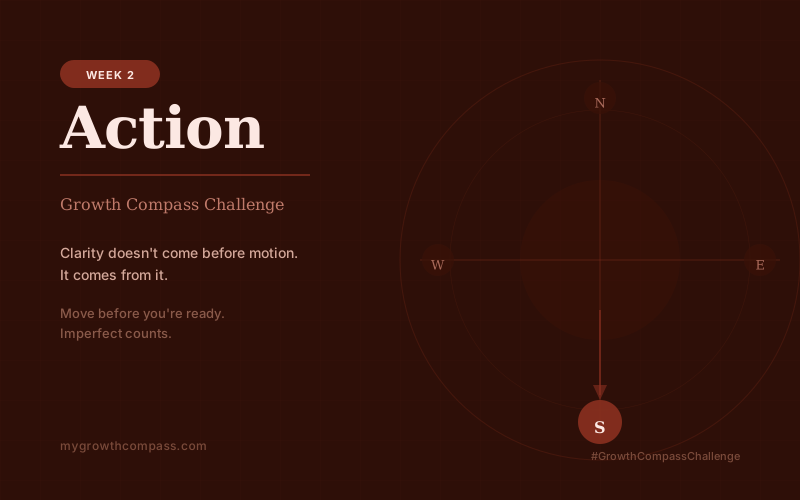
    Growth Compass Challenge Week 2: Action

    Clarity doesn’t come before motion. It comes from it.

    That’s the premise of Action Week — the second direction on the Growth Compass. Last week was about getting honest about where you are. This week is about moving from that place, before you feel ready, before you have it figured out.

    Most people wait for certainty before they act. But certainty is a result of action, not a requirement for it. The compass doesn’t point you somewhere and then tell you to move. It reveals direction through the act of moving.

    This is Week 2 of the Growth Compass Challenge. If you missed Week 1, start there — the Discovery prompts are still live and worth doing first.


    HOW THIS WORKS

    Each day this week has three parts:

    A compass prompt — a short provocation or insight to sit with.

    A micro-exercise — one concrete action, under 15 minutes.

    A reflection question — something to journal, think through, or share in the comments.


    DAY 8 — The Smallest Possible Step

    The block isn’t that you don’t know what to do. The block is that what you know you should do feels too big to start. Cut it smaller.

    Exercise: Take one thing from last week — a curiosity, an avoidance, a pull — and define the smallest possible action toward it. Not the right action. The smallest one. Do it today.

    Reflection: What would happen if you treated this small step as enough for today?


    DAY 9 — Change One Thing in Your Environment

    Your environment is either working for your direction or against it. Most people try to outperform their surroundings through willpower. That’s the harder path.

    Exercise: Identify one thing in your physical or digital environment that consistently pulls you away from where you want to go. Change, remove, or relocate it today. One thing only.

    Reflection: What would your space look like if it was deliberately designed around your current direction?


    DAY 10 — Do the Thing You’ve Been Overthinking

    There’s probably one specific thing you’ve been circling for days — researching, planning, reconsidering. At some point the thinking is no longer preparation. It’s a substitute for moving.

    Exercise: Identify the thing you’ve thought about most this week without doing. Do a version of it today. An imperfect version counts.

    Reflection: What were you actually waiting for?


    DAY 11 — Borrow Someone Else’s Momentum

    You don’t always have to generate your own energy to move. Sometimes the fastest way to get into motion is to get near someone who already is.

    Exercise: Find a podcast episode, book chapter, interview, or conversation with someone operating in a direction that interests you. Spend 20 minutes with it today. Notice what it stirs up.

    Reflection: Who in your life or in your feed makes you feel like your direction is possible? How much time are you spending near them?


    DAY 12 — Track What You Actually Do, Not What You Planned

    Plans are hypotheses. What you actually do is data. Most people review the plan. Few people review the execution.

    Exercise: At the end of today, write down what you actually did — not what you intended. No judgment. Just an accurate record. Compare it to what you planned this morning.

    Reflection: What does the gap between plan and action tell you about where your real resistance lives?


    DAY 13 — Ship Something Imperfect

    Perfection is a form of inaction dressed up as a standard. Finishing something imperfect teaches you more than polishing something forever.

    Exercise: Complete something today and call it done. A draft, a message, a decision, a small creative thing. Done means sent, posted, submitted, or committed to — not just finished in your head.

    Reflection: What is one thing you’ve been “almost done” with for more than a week?


    DAY 14 — Action Integration: What Did Moving Teach You?

    Seven days of motion generates more useful information than seven weeks of thinking about motion. That information is now available to you. Use it.

    Exercise: Write down three things you learned about yourself this week — not things you did, but things you learned from doing them.

    Reflection: What did action reveal that planning could not have?


    WHAT’S NEXT

    Week 3 drops next Monday: Reflection.

    Motion without reflection is just busy. Reflection turns experience into direction.

    Drop your Week 2 integration answer in the comments — what did moving teach you that thinking couldn’t?

  • 10 Books for the Discovery Phase (When You Don’t Know What You Want Yet)

    10 Books for the Discovery Phase (When You Don’t Know What You Want Yet)

    There is a specific kind of restlessness that does not have a clean name.

    You are not in crisis. Nothing is technically wrong. But something has shifted — quietly, without warning — and now you are reading articles at midnight, listening to podcasts on your commute, and comparing your path to people you barely know. You are consuming information at a pace that would suggest you are searching for something. You are just not sure what.

    That is the Discovery phase. And it is more common than most people admit.

    In the Growth Compass framework, Discovery is the first stage of the DARP cycle — the phase where you are questioning, exploring, and gathering signal before you have any clarity about direction. It sits at the East point of the compass. Not because it is where the journey ends, but because it is where most people actually begin: eyes open, orientation unclear, curiosity active.

    The tricky part about Discovery is that most self-help content is not built for it. Most books assume you already know what you want and just need a system to get there. They hand you a 90-day plan before you have figured out what you are planning for. That mismatch is why so many people in this stage read the books, take the notes, and still feel stuck.

    These 10 books are different. They are for the questioning stage, not the doing stage. They open possibilities instead of prescribing action. They are comfortable sitting with uncertainty — which is exactly what this phase requires.

    (Not sure which stage you are in? Start here: The Growth Compass Method: A Framework for Anyone Who Feels Lost.)

    1. Designing Your Life — Bill Burnett and Dave Evans

    This one was written specifically for people who do not have a clear direction yet. The premise is simple: you cannot think your way into a new life — you have to prototype it. Burnett and Evans, both Stanford design professors, walk you through low-stakes experiments that help you gather real information about what fits and what does not, without requiring a dramatic commitment first. It is the most practical book on this list for someone who is stuck in their head.

    2. Ikigai — Hector Garcia and Francesc Miralles

    The concept of ikigai — the Japanese idea of a reason for being — maps almost perfectly onto the Discovery phase. The book explores the intersection of what you love, what you are good at, what the world needs, and what you can be paid for. It does not give you the answer. It gives you a better set of questions, which is what Discovery actually requires.

    3. Big Magic — Elizabeth Gilbert

    This is the book to read if you are waiting for passion to arrive before you move. Gilbert argues that curiosity is a more reliable guide than passion, and that following curiosity — even when it seems small or impractical — is how most meaningful work actually starts. It reframes the entire search in a way that feels less desperate and more honest. Recommended especially if the restlessness feels creative in nature.

    4. The Alchemist — Paulo Coelho

    Yes, it is fiction. Yes, it belongs here. The Alchemist is about following a signal without knowing where it leads — which is the emotional experience of Discovery compressed into a story. It gives permission to not have the full picture yet. If you have already read it, read it again with the framework in mind. It lands differently.

    5. Man’s Search for Meaning — Viktor Frankl

    Frankl wrote this after surviving the Nazi concentration camps. It is not a light read, but it is a foundational one. His core argument is that meaning is not found — it is made, out of whatever circumstances you are in. For someone in Discovery who is waiting for life to feel meaningful before they commit to anything, this book is a quiet corrective. It is also short. You can read it in an afternoon.

    6. What Color Is Your Parachute? — Richard N. Bolles

    This book has been revised almost every year since 1970 because the core process still works. It is usually filed under career books, but it belongs in the Discovery phase for anyone — not just people changing jobs. The exercises are designed to help you understand what you are actually wired for before you decide where to point that energy. If you are blank-page stuck, this gives you something concrete to work with.

    7. StrengthsFinder 2.0 — Tom Rath

    The book comes with an access code for the CliftonStrengths assessment, which is the real value here. The assessment gives you language for things you are already doing naturally — talents you may have dismissed as unremarkable because they come easily to you. In Discovery, one of the most useful things you can do is get clearer on your own wiring. This makes that process faster.

    8. Maybe You Should Talk to Someone — Lori Gottlieb

    Gottlieb is a therapist who ends up in therapy herself. The book moves between her sessions with her own therapist and her sessions with four very different patients. It normalizes the exploration process — the confusion, the resistance, the slow emergence of clarity — in a way that is harder to get from a framework or a list. It also quietly argues that most people are asking the wrong questions about their own lives. Worth reading if the Discovery phase feels emotionally charged, not just logistically uncertain.

    9. The Artist’s Way — Julia Cameron

    This is a 12-week program built around two practices: morning pages (three pages of longhand, stream-of-consciousness writing every morning) and artist dates (solo weekly outings designed to feed your curiosity). It was written for creative blocks but works just as well for any kind of directional fog. Morning pages alone function as a Discovery tool — you write until you stop performing and start actually saying something. Something usually surfaces within a few weeks.

    10. Essentialism — Greg McKeown

    This might look like an Action book — and in some ways it is. But McKeown starts with something Discovery requires: a serious interrogation of what actually matters to you, stripped of what you think should matter. The first third of the book is about stepping back, observing, and questioning assumptions before making any moves. Read it as a thinking tool, not a productivity system.

    Which stage are you actually in?

    Discovery is just one point on the compass. Some people reading this are further along than they think — already in Action but stalling out. Others might be in Reflection without realizing it, processing something that happened rather than searching for something new.

    If you are not sure where you are in the cycle, The Growth Compass Method is a good place to start. It walks through all four stages and what each one actually feels like from the inside.

    And if you are deep in Discovery right now — restless, questioning, not quite sure what comes next — that is not a problem to fix. It is the beginning of a process. You are in the right place.

  • Growth Compass Challenge Week 1: Discovery

    Growth Compass Challenge Week 1: Discovery

    You can’t navigate from a location you won’t admit to.

    That’s the premise of Discovery Week — the first direction on the Growth Compass. Before you can figure out where you’re going, you have to be honest about where you actually are. Not where you wish you were. Not where you used to be. Where you are today.

    This is Week 1 of the Growth Compass Challenge: a free four-week cycle moving through Discovery, Action, Reflection, and Purpose. One direction per week. Seven prompts and exercises per week. No pressure to have it figured out before you start.

    That’s the whole point.


    HOW THIS WORKS

    Each day this week has three parts:

    A compass prompt — a short provocation or insight to sit with.

    A micro-exercise — one concrete action, under 15 minutes.

    A reflection question — something to journal, think through, or share in the comments.

    You don’t have to do every single one. Start with Day 1. See what happens.


    DAY 1 — Where Are You Actually Starting From?

    Most people begin a new challenge from where they wish they were. This one starts from where you are. The compass only works if you’re honest about your current position.

    Exercise: Write three sentences — no more — that describe where you genuinely are right now. Not goals. Not history. Today. Keep them.

    Reflection: What did you leave out of those three sentences because it felt uncomfortable to write?


    DAY 2 — What Are You Actually Curious About?

    Curiosity doesn’t show up as a grand calling. It shows up as a small, persistent pull toward something you keep thinking about, reading about, or mentioning in conversation.

    Exercise: Look at your browser tabs, your podcast queue, and the last five things you searched. Write down the theme you see. What subject keeps reappearing?

    Reflection: When did you last follow a thread of curiosity just to see where it went, with no goal attached?


    DAY 3 — What Are You Avoiding?

    Avoidance is directional. What you consistently sidestep tells you as much about your compass as what you move toward.

    Exercise: Write down one thing you’ve been putting off for more than two weeks. Underneath it, write the real reason — not the logistical excuse. The actual reason.

    Reflection: Is this avoidance protecting you from something, or just postponing it?


    DAY 4 — What Would You Try If Wasting Time Wasn’t a Risk?

    A lot of people aren’t afraid of failure. They’re afraid of finding out they spent months on something that didn’t lead anywhere. But discovery doesn’t work on a guarantee.

    Exercise: Name one thing you’ve wanted to explore but haven’t started because you couldn’t see the payoff in advance. Write it down. You don’t have to act on it yet — just name it clearly.

    Reflection: Where did the belief that exploration needs a justified outcome come from?


    DAY 5 — What Pulls You Without Prompting?

    You don’t have to manufacture passion. You already have pulls. Most people just override them before they can be useful.

    Exercise: Think about the last time you lost track of time doing something — not relaxing, actually doing something. What were you doing? Write it down and note how long it’s been since you did it.

    Reflection: If that pull isn’t part of your current direction, why not?


    DAY 6 — Who Are You When Nobody’s Watching?

    Your real priorities are the ones you keep when there’s no audience. Strip the performance and what’s left is closer to your true compass setting.

    Exercise: Look at your unscheduled hours this past week — the time you didn’t plan. Write down what you actually did with them, not what you intended to do. What does that reveal?

    Reflection: Is the person you are when no one is watching someone you would choose to be?


    DAY 7 — Discovery Integration: What Did This Week Reveal?

    Discovery isn’t about finding answers. It’s about asking better questions. One week in, the questions are already sharper than they were seven days ago.

    Exercise: Go back to your Day 1 sentences. Write three new ones about where you are today. Notice what shifted, even slightly.

    Reflection: What is one thing you now know about your current direction that you were not willing to see a week ago?


    WHAT’S NEXT

    Week 2 drops next Monday: Action.

    Clarity doesn’t come before motion. It comes from it.

    Drop your Week 1 reflection in the comments — what did Discovery reveal that you weren’t expecting?

  • What if Your North Star Has Been There the Whole Time?

    What if Your North Star Has Been There the Whole Time?

    What if your North Star has been there the whole time — just too dim to see?

    Most people who feel lost assume the same thing: that they’re missing something. That somewhere along the way a direction was supposed to arrive and it never did. That other people have some internal compass that simply wasn’t included in their version.

    That’s not what’s actually happening.

    In almost every case, the North Star is already there. It always has been. The problem isn’t absence — it’s visibility.

    The Star You Can’t Name

    Think about the people in your life who seem perpetually adrift. Not unhappy necessarily. Not unintelligent. Just never quite moving toward anything that feels like theirs.

    Look closer and you’ll almost always find it — a quiet, consistent thread running through everything they do. The person who gravitates toward taking care of others in every room they enter. The one who lights up around creative problems but spent thirty years in accounting. The natural teacher who never taught.

    The North Star was there. It just never got named. Never got turned into a heading.

    And without a heading, even the brightest internal light can’t guide you anywhere.

    Dim Isn’t Gone

    There’s an important difference between a North Star that doesn’t exist and one that exists but was never bright enough to navigate by.

    A lot of people are living the second one.

    Their direction expresses itself sideways — through habits, through the roles they fall into, through what they do for free when nobody is watching. But because nobody ever helped them see it clearly, it never became something they could consciously move toward.

    So instead of guiding them, it just follows them. Quietly. Unnamed. Never quite bright enough to cut through the noise of everything else life puts in front of them.

    What It Costs

    When your North Star stays dim, the decisions don’t stop. They just get made by other forces.

    Sometimes you follow whatever stars are closest — a stable job, a practical path, a life that made sense when the decision needed to be made. Nobody led you wrong. You just navigated toward whatever was lit up at the time. Without a clear North Star of your own, any light looks like direction.

    Sometimes there’s no wrong turn at all. Just enough comfort that the future never becomes more urgent than the present. Comfort doesn’t take you in the wrong direction — it just keeps you from moving at all. Time passes while everything feels fine enough.

    Either way the result is the same. A slow drift through decades of choices that were never quite yours — until one day you look up and wonder how you got here.

    The Work Is Recognition, Not Discovery

    This changes what it means to find your direction.

    It’s not about inventing something from scratch. It’s not about waiting for a revelation or taking a personality test or reading the right book at the right moment.

    It’s about learning to see what’s already there.

    That means paying attention to what consistently pulls at you. What you keep returning to. What makes you lose track of time. What you care about when nobody is rewarding you for caring.

    Your North Star doesn’t need to be created. It needs to be brightened.

    The compass doesn’t give you a new direction. It helps you recognize the one you’ve been carrying all along.

    That’s where we start.

  • Best Personal Development Books 2026: 10 Life-Changing Reads

    Best Personal Development Books 2026: 10 Life-Changing Reads

    Looking for the best personal development books in 2026? You’re in the right place. The fastest way to grow is learning from people who’ve already figured it out. These 10 best personal development books will help you build better habits, sharpen your mindset, and become the best version of yourself.

    This post contains affiliate links. If you purchase through these links I may earn a small commission at no extra cost to you.


    And here’s a bonus tip – pair each book with an AI tool like Claude or ChatGPT to help you apply what you learn to your specific situation. That combination is a growth shortcut most people haven’t discovered yet. Want to know how? Check out our guide on how to use AI to become the best version of yourself.


    Why These Are the Best Personal Development Books for 2026

    With thousands of self help books on the market it’s hard to know where to start. These 10 books made this list because they are practical, proven, and have genuinely changed lives. Whether you’re working on habits, mindset, fitness, focus, or confidence there’s something on this list for you.


    1. Atomic Habits by James Clear

    If you only read one of the best personal development books in 2026, make it this one. Atomic Habits breaks down exactly how habits form, why they stick or fail, and how to design your environment so good behavior becomes automatic. Clear’s system is practical, science-backed, and immediately applicable. Thousands of people credit this book with completely changing how they approach daily routines.

    [GET ON AMAZON HERE]


    2. The 5 AM Club by Robin Sharma

    Robin Sharma makes a compelling case for owning your morning before the world wakes up. The 5 AM Club introduces a powerful morning routine framework built around exercise, reflection, and learning. If you struggle with consistency or feel like you never have enough time, this book will shift your perspective entirely.

    [GET ON AMAZON HERE]


    3. Mindset by Carol Dweck

    Stanford psychologist Carol Dweck spent decades researching why some people achieve their potential and others don’t. The answer comes down to one thing – whether you have a fixed or growth mindset. This book will change how you think about talent, effort, failure, and learning forever.

    [GET IT ON AMAZON HERE]


    4. Can’t Hurt Me by David Goggins

    David Goggins is a former Navy SEAL who went from a troubled childhood and obesity to becoming one of the world’s top endurance athletes. This book is raw, honest, and genuinely uncomfortable in the best possible way. If you need a mental toughness reset, nothing hits harder than this.

    [GET IT ON AMAZON HERE]


    5. The Power of Now by Eckhart Tolle

    In a world of constant distraction and anxiety about the future, Eckhart Tolle’s classic reminds us that the present moment is the only place where real life happens. The Power of Now has sold millions of copies worldwide and remains one of the most powerful books on mindfulness and inner peace ever written.

    [GET IT ON AMAZON HERE]


    6. Think and Grow Rich by Napoleon Hill

    Written in 1937 and still selling millions of copies, Think and Grow Rich is one of the most influential personal development books ever published. Hill studied hundreds of the most successful people of his era and distilled their habits and mindsets into 13 principles anyone can apply. A timeless classic that belongs on every serious reader’s shelf.

    [GET IT ON AMAZON HERE]


    7. The 4-Hour Workweek by Tim Ferriss

    Tim Ferriss changed how an entire generation thinks about work, time, and lifestyle design. The 4-Hour Workweek challenges the conventional idea of retiring at 65 and instead shows you how to design a life of freedom and flexibility right now. Packed with practical strategies for automating your income, eliminating time wasters, and living life on your own terms. A must-read for anyone using AI to build smarter systems and reclaim their time.

    [GET IT ON AMAZON HERE]


    8. Deep Work by Cal Newport

    In a world full of distractions, the ability to focus deeply on difficult tasks is becoming both rare and incredibly valuable. Cal Newport makes the case that deep, distraction-free work is the superpower of the modern age. If you want to produce better results in less time this book is essential reading.

    [GET IT ON AMAZON HERE]


    9. The 7 Habits of Highly Effective People by Stephen Covey

    Stephen Covey’s masterpiece has sold over 40 million copies and is still required reading in business schools and leadership programs worldwide. The 7 habits Covey outlines are timeless principles that apply to every area of life from relationships to career to personal growth. If you haven’t read this yet, 2026 is the year.

    [GET IT ON AMAZON HERE]


    10. You Are a Badass by Jen Sincero

    Jen Sincero’s wildly popular book is the perfect blend of no-nonsense advice and genuine humor. Written for people who know they’re capable of more but can’t seem to get out of their own way, You Are a Badass is the kick in the right direction that a lot of people need. Especially powerful for anyone working on self confidence and overcoming limiting beliefs.

    [GET IT ON AMAZON HERE]


    The Bottom Line

    The best personal development books in 2026 are only as powerful as the action you take after reading them. Pick one book from this list, commit to finishing it this month, and use AI tools to help you apply what you learn. That combination of timeless wisdom and modern AI is what separates people who grow from people who just have good intentions.

    Which of these best personal development books are you starting with? Drop it in the comments below.

Train Your Compass